


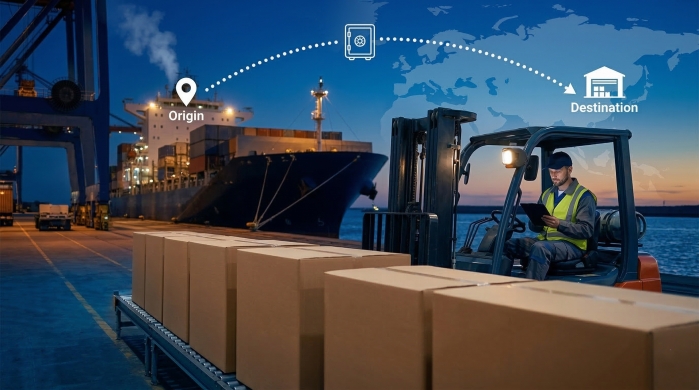
Why is Shipping So Expensive for Newbie Adult Toy Wholesalers? (Plus Practical Saving Tips)
2026-03-17 16:44:49Many newcomers looking to get into the adult product sales industry often only focus on the "factory price". They are often stunned when the adult toy supplier finally quotes the shipping cost, asking, "How is the shipping cost almost as much as the product's value?!"
The truth is, cross-border logistics for sex toys have their unique challenges. Understanding the logic behind this will help you avoid these "shipping cost traps" in your startup phase and re-evaluate if wholesaling adult products from overseas is right for you.
1. The Courier Company's "Unspoken Rule": Volumetric Weight
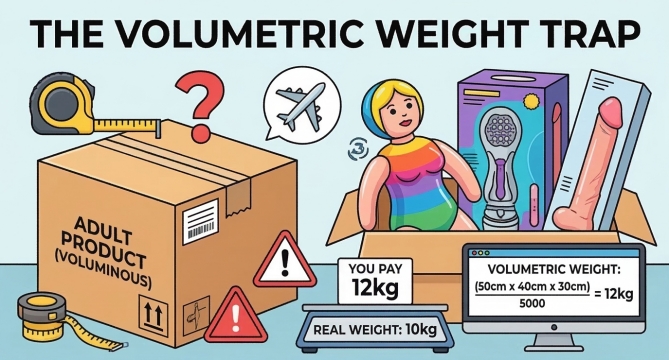
This is the easiest point for beginners to overlook. Sex toys (especially masturbators, dolls, and large vibrators) often come in fancy, bulky packaging but aren't actually very heavy.
The Problem: International couriers (like DHL/FedEx/UPS) don't just charge by the actual weight on the scale. They charge based on whichever is greater: the "volumetric weight" or the "actual weight."
Calculation Formula: Length (cm) × Width (cm) × Height (cm) / 5000 = Volumetric Weight (kg).
Example: You wholesale a batch of sex dolls. Their actual weight might only be 10kg, but after packing, their volumetric weight could be calculated as 25kg. You'll have to pay for 25kg, and that's why your shipping cost can instantly double.
2. Too Small Starting Volume: Haven't Reached the "Price Tier" Threshold
The logistics industry is a classic example of "the more you ship, the better the price."
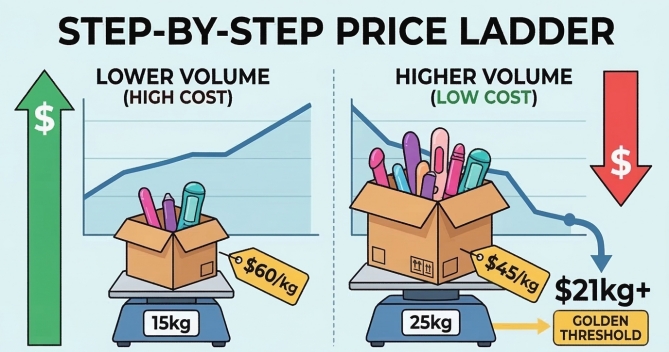
Tiered Pricing: International logistics usually have tiers like 21kg, 45kg, 100kg, etc. For example, the unit price for sending 15kg might be 60 dollars/kg, but if you combine enough items to reach over 21kg, the unit price might drop to 45 dollars/kg.
3. The "Sensitive Goods" Premium: The Cost of Special Status
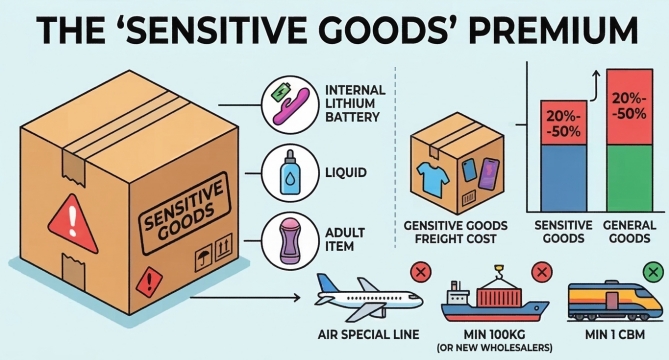
Sex toys are categorized as "Sensitive Goods" in logistics for three main reasons:
Contain Batteries: Most vibrating products have built-in lithium batteries, which are classified as dangerous goods for air freight and require special battery shipping channels.
Contain Liquids: Lubricants and cleaning solutions are liquids, which have very strict customs clearance and transportation requirements.
Product Nature: Some countries have inspection requirements for adult products, meaning freight forwarders take on higher customs clearance risks.
As a result, the unit shipping cost for sex toys is naturally 20-50% higher than for "general goods" like clothes or phone cases.
4.Exclusive Shipping Methods: Beginners Often Have Limited Choices
Sea/Rail Freight: While extremely cheap (unit price can be 1/4 of air freight), they usually have a "minimum shipping quantity" (e.g., starting from 100kg or 1 cubic meter). Beginners with insufficient cargo volume simply can't use these affordable channels.
Air Freight Special Lines: These are the preferred choice for beginners. While more expensive than sea freight, they are faster and more reliable than general international couriers like DHL.
The Beginner Entrepreneur's "Save Money" Trilogy: How to Outrun Shipping Costs?
To prevent shipping costs from eating into your hard-earned profits, in the initial stages, you don't need to get bogged down with complex logistics formulas. Just try these three practical steps:
Step 1: Target the 21kg "Golden Threshold"
In international air freight, 21kg is a watershed. Below 21kg, it's usually charged as "small packages" with a very high unit price; once you exceed 21kg, you enter the "bulk cargo special line" category, and the unit price will significantly decrease.
Keep in Mind: If you're wholesaling standard-sized vibrators, 21kg would mean roughly 50 pieces or more; for smaller items like vibrating rings or bullet vibrators, the quantity might need to reach over 100 pieces.
Calculation Logic: When placing an order, do the math: can the increased product cost from adding 20 more items to reach 21kg be offset by the total shipping cost saved? Many times you'll find that "buying a bit more" actually results in a lower overall expenditure than "buying less."
Step 2: Hitch a Ride with "Consolidated Shipping" (Key for Beginner Breakthrough)
If you genuinely only want to order 5kg or 10kg to test the waters and simply can't meet the 21kg bulk cargo threshold, don't stubbornly pay for expensive international express shipping. Learning to "find your own consolidation service" is the smartest approach.
How to Do It (Practical Process):
Find Your Own "Consolidation Freight Forwarder": Look for logistics companies in the market that specialize in "scattered cargo consolidation" or "consolidated shipping with tax included." They have existing warehouses specifically for collecting small, individual orders like yours.
Supplier Ships to Domestic Freight: You simply need to ask your supplier to send the goods to your designated domestic transit warehouse.
Logistics Company Consolidates: The freight forwarder will combine your goods with hundreds or thousands of other sellers' goods. Once they have enough to fill a container or an air cargo pallet, they will ship everything together.
Key Benefits and Drawbacks:
Benefits: Even if you only have 5kg of goods, you can indirectly enjoy the "ton-level" logistics unit prices typically available to large sellers, protecting your profit margins without having to remove product retail boxes.
Drawback (Important Reminder): Consolidation means you'll have to "wait." It's like taking a bus – it won't leave until it's full. This method typically takes 7-10 days or even longer than direct commercial express shipping. If extreme speed is your priority, consolidation might not be for you; but if extreme cost-saving is your goal, this is the best option.

Step 3: Stick to DDP (Delivered Duty Paid) Channels
For beginner entrepreneurs, the biggest fear is having goods seized at the destination customs or being asked to pay a bunch of incomprehensible taxes. Therefore, it's crucial to choose DDP (Delivered Duty Paid) channels.
Why Choose It: The shipping quote for this method is a "fixed price" that already includes export customs clearance, international freight, destination country import customs clearance, and all taxes.
Peace of Mind: While its apparent unit price might seem a bit higher than some non-DDP channels, it has no hidden costs and, more importantly, no risk of your goods getting "stuck at customs." For beginners, "controllable costs" are far more important than "the lowest price."
Summary Advice:
Logistics isn't a burden; it's your leverage. In the startup phase, either gather enough goods to hit 21kg for bulk pricing, or find a logistics company to consolidate your shipment and hitch a ride. Finally, use DDP channels to cover your risks. As long as you follow these three steps, your product will have a strong foundation for price competitiveness in the market.
Conclusion: High shipping costs are the "tuition fee" all beginners pay, but by reaching quantity tiers and choosing the right channels, you can absolutely keep shipping costs within a reasonable range.
FAQ 1: Why Does Ordering Less Often Lead to More Losses?
Many beginners, when first trying overseas wholesale, often have a "small steps" mindset, wanting to order just a few dozen items to test the waters. They typically aim for 5kg to 10kg of goods (which translates to dozens to about a hundred sex toys). But this "testing the waters" mindset often leads to newcomers hitting a wall with logistics costs.
Reason 1: "Scattered Small Parcels" - A Negotiation Hell: In international logistics, a 5-10kg package is defined as "scattered small cargo." The awkwardness of this weight class is that it's too small to benefit from the cheap bulk rates of sea or rail freight, and too small to hit the "bulk discount tiers" of air freight special lines. You're forced to choose standard international commercial couriers like DHL, UPS, or FedEx. These courier giants charge extremely high rates for small packages, not only for the initial weight (first 0.5kg) but also because you have no bargaining power whatsoever.
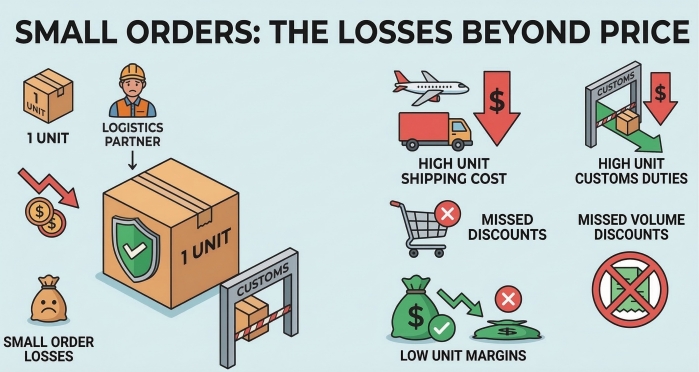
Reason 2: The "Per-Item Nightmare" of Untapped Shipping Costs: Logistics involves many "fixed costs," such as export customs declaration fees, warehousing fees, fuel surcharges, etc. When you only ship 10kg, these fixed costs are spread across very few products. You'll find that the average shipping cost per item can be several dollars or even more, directly eating away all your anticipated profit.
Reason 3: The Logic Behind Supplier MOQs (Minimum Order Quantities): Many beginners complain that supplier MOQs are too high, feeling that manufacturers are deliberately raising the bar to make it hard for small sellers. But the opposite is often true – high MOQs are sometimes a protective measure by the supplier for the seller. Suppliers know that only when your total order weight exceeds a certain threshold (like the 21kg sweet spot for air freight special lines) can they use their cargo volume to "negotiate prices" with freight forwarders for you. Above this weight, the logistics channel switches from expensive "retail express" to cost-effective "commercial special lines," and the unit shipping price instantly drops a tier.
Reason 4: The "Shipping Cost Inversion" Phenomenon that Discourages Beginners: The most frustrating moment for beginners is often when they've painstakingly selected hundreds of dollars worth of popular products, only to be quoted a shipping cost that also runs into hundreds of dollars. This phenomenon, where "shipping costs are higher than the product value," is called "shipping cost inversion" in professional terms. For most entrepreneurs trying overseas wholesale for the first time, this visually impactful cost structure is hard to accept. They often start doubting themselves: "Is the supplier ripping me off on shipping?" or "This industry is impossible to do."
Solution: Logistics companies won't give you a discount just because you're "testing the waters." If you want to be competitive in the startup phase, you must overcome the "logistics scale" hurdle. Either increase your purchase quantity, or find a logistics company yourself to see if they can help you consolidate your shipment with others.
FAQ 2: Why Do Wholesale Shipping Quotes Always Change?
One of the most annoying things for beginners in cross-border wholesale might be: you were quoted 50 dollars/kg yesterday, but today, when you're ready to order, it's 55 dollars. This "different price every day" fluctuation often makes sellers feel that wholesalers are playing tricks.
Actually, the logic behind this is very similar to "buying stocks" or "booking airline tickets."
1.The Role of the Freight Forwarder: The "Expedia" of the Logistics World: You must understand that most wholesalers don't own planes or ships themselves. Their logistics partners are usually first or second-tier freight forwarders. These freight forwarders are like "super middlemen" in the logistics world; they have access to dozens, even hundreds, of different "channel" resources. Some channels specialize in fast UPS routes, some handle "battery/liquid" sensitive goods, and others run niche special lines to Eastern Europe. Their daily job is to "shop around" these hundreds of channels, looking for the most stable and cost-effective solution at that moment.
2. Why Can't Prices Be "Fixed"?
The "Rollercoaster" of Fuel Surcharges: The price of international aviation fuel fluctuates in real-time. Logistics companies adjust their "fuel surcharges" weekly (or even every few days) based on oil prices.
Cabin Space Supply and Demand Game: This is a typical "highest bidder wins" market. For example, before Black Friday, Christmas, or Chinese New Year, when goods globally need to be shipped, airplane cargo space becomes a scarce resource. Freight forwarders have to pay more to secure space, naturally driving prices up.
Channel "Opening and Closing": Especially for "sensitive goods" like sex toys, certain cheap channels with smooth customs clearance might suddenly close due to policy adjustments. Once closed, the freight forwarder has to temporarily switch to more expensive but more reliable channels.

3. The "Unspoken Rule" of Quote Validity:
In the cross-border logistics industry, a quote's "shelf life" is typically only 24 to 48 hours. When a wholesaler gives you a shipping quote, they are essentially relaying the freight forwarder's real-time quote at that exact moment. If you delay confirming your order for three to five days, the original cheap cargo space might have already been booked by someone else, or the prices for that route might have been updated. This is why experienced sellers often place orders quickly and book space when they see a suitable shipping quote.
4. The Invisible Hand of Exchange Rate Fluctuations: Most international logistics are settled in US Dollars (USD). If you're settling in your local currency, even small fluctuations in the exchange rate, when applied to hundreds of kilograms of goods, can result in noticeable changes in the unit shipping price.
Practical Advice for Beginners:
Don't Obsess Over Small Fluctuations: A 5-10% fluctuation in shipping costs is normal in the industry. Instead of waiting a week to save a few dollars, it's often better to get your goods shipped sooner to gain a sales advantage.
Trust Your Long-Term Partner: A reliable wholesaler wants cheaper shipping costs even more than you do, because lower shipping costs mean higher profits for you, which helps their business in the long run. They will usually help you monitor the most reliable channels, not the cheapest ones that are prone to losing goods.
FAQ 3: Why Doesn't My Country Have DDP (Delivered Duty Paid) Channels?
Many beginners assume that as long as they have money, DDP can deliver goods to any corner of the Earth. But the reality is harsh: in some countries, "DDP" channels for sex toys simply don't exist.
Why don't these countries have DDP channels?
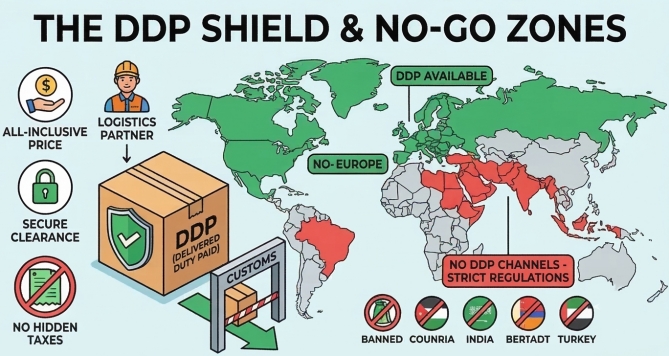
Legal Classification Issue: In these countries, sex toys are not seen as "daily necessities" or "massage devices" but are classified as "obscene objects" or "prohibited items."
Too High Collateral Risk: DDP freight forwarders usually consolidate hundreds or thousands of sellers' goods into one large container. If just one package containing sex toys is discovered by customs, it could lead to the entire container being seized, or even the freight forwarder's local customs clearance license being revoked. No legitimate freight forwarder is willing to take on this kind of risk.
Countries Where DDP for Sex Toys Is Difficult/Impossible:
Middle East: Saudi Arabia, UAE, Qatar, Kuwait, Iran, etc.
Reason: Heavily influenced by religious laws, sex toys are strictly considered prohibited items. Customs inspection rates are extremely high, and if discovered, goods are immediately confiscated, and the recipient might even face legal summons.
Some Southeast Asian Countries: Thailand, Vietnam, Malaysia.
Reason: Despite their developed tourism, these countries have very strict import controls on sex toys legally (e.g., Thailand classifies them as obscene materials). While they are sold in local markets, it's mostly through highly specialized grey channels that regular logistics cannot use.
India:
Reason: Indian customs have immense discretionary power. According to Article 292 of its Penal Code, any "obscene object" is strictly prohibited from import. Although policies fluctuate, there are currently almost no stable DDP channels, and the probability of seizure is extremely high.
Maldives:
Reason: Purely religious prohibition; 100% impossible to import through normal channels.
Turkey:
Reason: Turkish customs are known for being "strict and unpredictable." They scrutinize commercial packages almost harshly, often requiring recipients to provide specialized import permits. For adult products, scrutiny is even stricter.
Brazil:
Reason: Brazil is famous as a "logistics black hole." Its import tariffs can be as high as 60% or even more. Most critically, Brazilian law prohibits foreign companies from paying import taxes on behalf of recipients, meaning a true DDP (Delivered Duty Paid) is technically very difficult to achieve.
What if You're in These "Forbidden Zones"?
In the adult product industry, if a wholesaler confidently promises you that "DDP (customs clearance and tax included) can deliver to any country worldwide," don't get excited too quickly; instead, raise an eyebrow. This is highly likely to be an irresponsible sales trap – they might just want to ship the goods, and whether they get seized, fined, or destroyed by local customs is your problem after signing.
If you are indeed in one of the "customs clearance black holes" or legally restricted zones mentioned above, instead of stubbornly pursuing non-existent DDP, try the following more professional strategies:
Scheme A: Revert to Traditional Trade Model
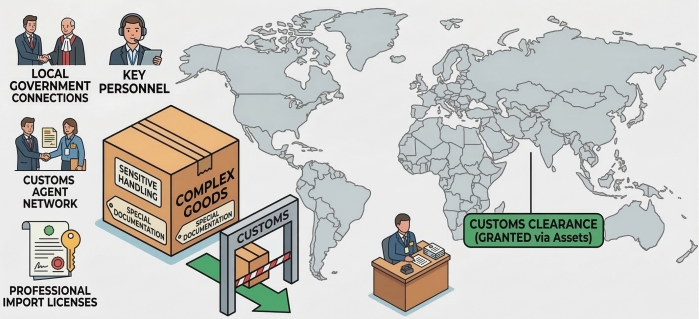
When the "tax-inclusive" route isn't viable, suppliers will switch the business model from DDP to DAP (Delivered At Place) or CIF (Cost, Insurance, and Freight).
Who it's for: Mature buyers with strong local government connections, customs clearance agent resources, or professional import licenses. This is why many suppliers ask if you have customs clearance experience or capability. If not, you might not be able to retrieve your purchased goods from your country's customs. If the goods get stuck, you'll not only lose the product cost but also incur expensive return shipping or destruction fees.
Scheme B: Break It Down, Use "Small Packages" to Maneuver
Since large wholesale logistics will attract customs attention, don't use commercial bulk cargo channels. Instead, use postal small packages for fragmented shipping.
Logic: Postal systems handle enormous volumes of parcels (tens of millions daily), and customs typically use a "spot-check" system. Because your package is small and inconspicuously packaged, the chance of it being selected for inspection is greatly reduced, often "slipping through" like a normal gift.
Drawbacks of Small Packages:
Slow Shipping: Postal small packages can take 20-40 days or even longer to arrive, severely testing customer patience.
No After-Sales Support: If a package is lost or seized through this channel, there's almost no compensation mechanism.
Who it's for: Sellers with very small order quantities (a few kilograms), who are extremely sensitive to costs, and can tolerate a certain risk of loss.
Scheme C: Utilize Third-Party Overseas Warehouses/Transit Countries for "Indirect Entry"
When a destination country's customs is as strict as an iron curtain, many veteran sellers adopt a "detour tactic." They won't ship directly from China to the forbidden zone but will first send goods to a transit hub with more lenient logistics policies and a more mature customs clearance system.
Operation Logic: For example, using Dubai as a springboard to enter the Middle East (Saudi Arabia, Kuwait), or using Poland/Hungary as a gateway to strictly controlled Eastern European regions. Goods first enter a transit country warehouse as general cargo. Then, local freight forwarders specializing in "grey customs" or having special customs clearance quotas will break down the shipment and "sneak" them into the forbidden country in batches.
Core Advantage: This method avoids the "high scrutiny" of shipping sensitive goods directly from China, using trade between transit countries as cover. Its safety is indeed much higher than direct registered mail or express delivery.
A "Cold Shower" for Beginners: The Fatal Flaws of This Scheme
While it sounds reliable, for beginners with limited capital and experience, this scheme hides several huge pitfalls:
Exorbitant Capital Threshold and Cash Flow Pressure: This "secondary transit" means you pay two sets of shipping fees, plus additional handling fees, storage fees at the transit warehouse, and "special channel" customs clearance premiums. This will drastically squeeze your profit margins, potentially even doubling the per-item cost.
Overly Long Supply Chain, Increased Risk of Loss of Control: Goods flow between China, the transit country, and the destination country. The longer the chain, the more uncontrollable factors there are. If something goes wrong at any point (e.g., the transit warehouse is overloaded or local policies change suddenly), your goods might get stuck in a third country, leaving you in limbo, and a beginner simply doesn't have the resources to "rescue" goods across borders.
Trust Issues and "Blackmail": Freight forwarders who handle "grey customs" or special channels often operate in a legal gray area. It's very difficult for beginners to distinguish genuine agents from fraudulent ones. You might often encounter situations where goods are shipped, but the agent disappears, or they suddenly raise prices ("sit on the price"). Because this type of trade is inherently opaque, you might not even be able to report it to the police for legal recourse.
Communication Burden and Time Zone Agony: You'll need to coordinate with the supplier, the transit warehouse agent, and the final customs clearance agent simultaneously. For beginners who don't speak the local language or are unfamiliar with international trade procedures, handling such multi-party coordination often leads to frustration and a high risk of errors in documentation or instructions.
Hot Products

Dog Dildo with Raised Veins
...

Fantasy Knotted Horse Dildo
...

Multiple Knots Horse Dildo
...

Fantasy Butt Plug with Veins
...

Thick Knot Octopus Suckers Dildo
...

Ribbed Alien Tentacle Dildo
...

9.8" Silicone Tentacle Dildo
...

Tentacles and Raised Knot Dildo
...

Animal Egg Shaped Anal Plug Set
...

Inflatable Fantasy Monster Dildo
...
Hot News

Why Sex Toys Have Different Hardness: How to Achieve It?
When customers buy sex toys, the feel and sensation are key to a great experienc....

Integrating Electrostatic Ion Balls into Adult Novelties: A Blush Rattle Snake Case Study
With the technological evolution in the adult product industry, one-directional ....

API EXPO 2026 Shanghai: Overseas Visitor Guide & Checklist
As a professional platform for global exchange in the adult products industry, A....

No Brazil Customs Clearance? Why Chinese Sex Toy Factories Suggest Local Wholesale
For entrepreneurs looking to enter the Brazilian adult toy market, importing dir....

Why Is the Minimum Order Quantity So High for Custom Adult Toys?
New entrepreneurs often come to me, asking: "I want to create my own brand. Can ....
Why is Shipping So Expensive for Newbie Adult Toy Wholesalers? (Plus Practical Saving Tips)
Many newcomers looking to get into the adult product sales industry often only f....

Legal Regulations and Compliance Requirements for Wholesale Sex Toys
Many newcomers, when they see terms like "EU CE," "US FDA," or "REACH testing," ....

Want to Launch Your Own Sex Toy Brand? What Support Can Manufacturers Offer?
Learn about the support sex toy manufacturers can offer when launching your own ....

We-Vibe How Promotion on Social Media and Ads
With the rise of e-commerce and social media platforms, marketing has become ess....

What Kind of Girls Use Sex Toys?
Yesterday while surfing the internet, I came across this statement: girls who us....
New products
Dog Dildo with Raised Veins
...
Fantasy Knotted Horse Dildo
...
Multiple Knots Horse Dildo
...
Fantasy Butt Plug with Veins
...
Thick Knot Octopus Suckers Dildo
...
Ribbed Alien Tentacle Dildo
...
9.8" Silicone Tentacle Dildo
...
Tentacles and Raised Knot Dildo
...
Animal Egg Shaped Anal Plug Set
...
Inflatable Fantasy Monster Dildo
...